
Introduction
For all neoprene OEM customization projects, whether for wetsuits, sports protective gear, daily accessories or industrial rubber products, the most fundamental material selection is choosing between CR neoprene vs SBR neoprene. These two are the most mainstream neoprene grades on the market, with huge differences in raw material composition, physical properties, service life and manufacturing cost.
Many new OEM buyers confuse CR and SBR neoprene, resulting in mismatched material selection, product performance degradation or excessive cost waste. SBR neoprene is cost-effective for daily conventional products, while CR neoprene is a high-grade professional material for outdoor, water sports and long-term use scenarios. As a mature neoprene OEM manufacturer, Yonghe Sport provides both CR and SBR material customized production. We can match the most suitable material grade according to brand positioning and product needs through our neoprene OEM service, ensuring product quality meets market standards.
What Is SBR Neoprene?
SBR neoprene is made of styrene-butadiene rubber composite foam material, which is the most common entry-level neoprene on the market. It features low raw material cost, mature production technology and stable batch consistency, suitable for large-scale mass production.
SBR neoprene has basic waterproof, shockproof and thermal insulation functions, meeting the use needs of daily casual products. However, it has obvious performance shortcomings: poor elasticity, easy deformation after long-term stretching, weak UV and seawater aging resistance, and obvious odor after production. It is a cost-effective choice for low and mid-end wholesale products.
What Is CR Neoprene?
CR neoprene, also known as chloroprene rubber neoprene, is a high-grade professional neoprene material. It adopts high-purity chloroprene rubber foaming formula, with fine and uniform closed-cell structure, no impurities and excellent comprehensive performance.
Compared with SBR neoprene, CR neoprene has super high elasticity, strong recovery, excellent seawater corrosion resistance, UV anti-aging performance and low-temperature resistance. It is odor-free, skin-friendly and not easy to deform or fade after long-term use. It is the designated material for high-end wetsuits, professional sports protective gear and outdoor durable products.
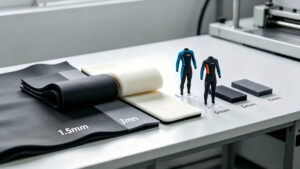
Core Performance Comparison: CR Neoprene vs SBR Neoprene
1. Elasticity & Recovery Performance CR neoprene has superior four-way stretch performance, soft and flexible texture. It can stretch freely with human body and equipment movement, and quickly rebound to the original state without permanent deformation after repeated stretching. SBR neoprene has stiff texture, poor elasticity and slow recovery. Long-term use is prone to looseness, deformation and sagging, greatly affecting the product fitting effect.
2. Anti-Aging & Weather Resistance CR neoprene has excellent outdoor weather resistance, resisting UV radiation, seawater erosion and high and low temperature changes. It will not harden, crack or fade after years of outdoor and marine use. SBR neoprene has poor anti-aging ability. Long-term exposure to sunlight and seawater will accelerate aging, harden the material, reduce elasticity and shorten product service life.
3. Waterproof & Thermal Insulation CR neoprene has dense and uniform closed-cell foam structure, which can effectively lock air, isolate cold air and seawater penetration, with stable thermal insulation and waterproof performance. SBR neoprene has uneven internal pores, poor air tightness, easy water seepage and heat loss, and its thermal insulation effect is far inferior to CR materials in low-temperature environments.
4. Safety & Skin-Friendliness High-grade CR neoprene is environmentally friendly and odor-free, compliant with REACH and international textile safety standards, hypoallergenic and suitable for long-term skin contact. SBR neoprene may have slight rubber odor, with ordinary environmental protection grade, and is not recommended for high-end wearable products and children’s products.
5. Cost & Market Positioning SBR neoprene has low raw material and production costs, suitable for budget wholesale, promotional products and daily ordinary accessories. CR neoprene has a moderate cost premium, positioned in mid-to-high-end retail, professional sports and outdoor durable product lines, with higher product added value.
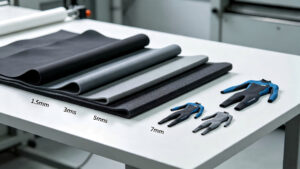
Applicable OEM Scenarios for CR & SBR Neoprene
SBR Neoprene Application Scenarios Daily neoprene cup sleeves, laptop sleeves, ordinary storage bags, casual fitness mats, promotional gift accessories, indoor ordinary protective sleeves and low-budget bulk wholesale products. It focuses on cost performance and basic use functions.
CR Neoprene Application Scenarios Professional surfing and diving wetsuits, cold-water thermal suits, sports knee/elbow pads, outdoor protective gear, marine accessories, children’s wearable products and high-end customized retail products. It focuses on durability, comfort and professional performance.
FAQ
Q1: Is CR neoprene always better than SBR neoprene? A1: CR neoprene has better comprehensive performance, but SBR is more cost-effective for ordinary daily products. The best choice depends on your product usage scenario and brand positioning.
Q2: Can SBR neoprene be used for outdoor water sports? A2: It is not recommended. SBR neoprene is poor in anti-aging and waterproof performance, easy to age and leak water in outdoor marine environments, which affects the user experience.
Q3: Do you support mixed CR and SBR neoprene customization? A3: Yes. We support hybrid material design, using CR neoprene for key wearable and waterproof parts and SBR neoprene for auxiliary parts to balance product quality and wholesale cost.
Conclusion
The difference between CR neoprene vs SBR neoprene determines the grade, service life and market competitiveness of neoprene products. SBR neoprene is the preferred material for cost-effective daily accessories, while CR neoprene is the high-quality choice for professional, durable and high-end OEM products. If you have material selection confusion or customized neoprene production demands, contact Yonghe Sport to get free material samples and professional one-stop OEM solutions.