
Introduction
For high-end surfing, triathlon and cold-water diving wetsuit OEM projects,GBS seam vs taped seam neoprene wetsuit is the most critical advanced craftsmanship decision that separates mid-range products from professional-grade gear. While flatlock and overlock stitches focus on exterior comfort, GBS and taped seams define the ultimate waterproof capability, thermal retention and long-term durability of premium neoprene wetsuits.
Many brand buyers mistakenly treat taped seams and GBS seams as the same premium process. In fact, their internal structure, stretch performance and waterproof logic are completely different, leading to distinct market positioning and price gaps. As a professional high-grade neoprene OEM manufacturer, Yonghe Sport provides full-process premium seam solutions, including GBS blind stitching and internal taped reinforcement. All professional wetsuit craftsmanship can be customized through ourneoprene OEM service to match your brand’s high-end product line standards.
What Is GBS (Glued Blind Stitch) Seam?
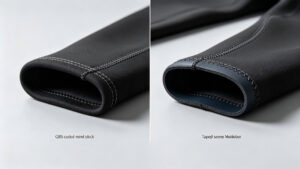
GBS stands for Glued Blind Stitch, the gold-standard craftsmanship for professional neoprene wetsuits. The production process first glues neoprene panels together to form a fully sealed waterproof base, then performs half-penetration blind stitching. The needle only pierces half of the neoprene foam instead of running through the entire material, leaving zero through-hole leakage points.
This unique structure retains 100% waterproof integrity while adding powerful tensile strength. The blind stitch does not break the closed-cell foam barrier, ensuring no cold water flushing inside the wetsuit. Meanwhile, GBS seams deliver excellent natural stretch, perfectly fitting body movements during surfing and diving. It is widely recognized as the most reliable process for cold-water and long-duration water sports.
What Is Taped Seam?
Taped seam is a popular upgraded waterproof reinforcement process for mid-to-high-end wetsuits. Manufacturers first sew the neoprene panels conventionally, then apply waterproof rubber tape on the internal seam gaps through hot pressing. The sealing tape covers needle holes and stitching gaps to block water penetration.
Taped seam effectively improves the waterproof performance of ordinary stitched wetsuits and enhances seam abrasion resistance. However, since the stitching fully penetrates the neoprene material, tiny structural gaps still exist. Under long-term deep water pressure and repeated stretching, slight water seepage may gradually occur. It is ideal for temperate water sports and high-value casual wetsuit lines.
Core Comparison: GBS Seam vs Taped Seam Neoprene Wetsuit
1. Waterproof & Thermal Retention Performance GBS glued blind stitch achieves fundamental zero through-hole structure. The integral glue bond completely isolates seawater, preventing cold water flushing and constant heat loss, stable for long-time deep diving. Taped seams rely on external tape coverage to block needle holes. Although waterproof in conventional scenarios, high water pressure or aging tape may cause slow seepage, resulting in weaker thermal insulation than GBS craftsmanship.
2. Stretch & Wearing Flexibility GBS blind stitching does not restrict foam elasticity. The seam stretches synchronously with the whole neoprene panel, providing unrestricted limb movement and ultra-smooth fitting. Taped seams have relatively rigid tape layers on the inner side, slightly limiting extreme stretching and reducing flexibility during high-intensity sports.
3. Durability & Anti-Aging Performance GBS integrated glue structure distributes tension evenly, avoiding concentrated seam stress. It resists peeling, cracking and thread loosening after years of repeated use and washing. Taped seams depend on tape adhesion. After long-term seawater erosion and high-frequency stretching, the tape edge may lift, gradually reducing waterproof effectiveness.
4. Comfort & Skin-Friendly Experience GBS internal structure is flat and seamless without raised layers, bringing zero friction skin contact. Taped seams have thin rubber tape stacking on the inner seam, which may cause slight squeezing feeling during long-time wearing.
5. Cost & Product Positioning GBS requires precise manual gluing and professional blind stitch machines, with high labor and technical thresholds, belonging to professional top-grade craftsmanship. Taped seam has moderate cost, suitable for mid-high end retail products with balanced quality and budget.
Best OEM Application Scenarios
Choose GBS Seam If: You develop professional cold-water diving suits, triathlon wetsuits, high-end surf competition gear, and premium brand technical lines that require zero leakage and long durability.
Choose Taped Seam If: You focus on mid-premium retail wetsuits, temperate water surfing gear, and high-quality casual water sport products, pursuing improved waterproof performance at a reasonable cost.
FAQ
Q1: Is GBS seam completely waterproof than taped seam? A1: Yes. GBS eliminates through needle holes fundamentally, while taped seam only covers holes externally. GBS provides more stable waterproof performance under long-term use and high water pressure.
Q2: Are GBS wetsuits worth the higher OEM cost? A2: Absolutely for premium brands. GBS greatly reduces after-sales leakage complaints, improves product reputation and supports high retail pricing, bringing higher profit margins.
Q3: Can you customize mixed GBS and taped seam structure? A3: Yes. We support hybrid craftsmanship, applying GBS on key body waterproof areas and taped seams on auxiliary parts to balance top performance and manufacturing cost.
Conclusion
When selecting GBS seam vs taped seam neoprene wetsuit for OEM projects, there is a clear grade difference. Taped seam is an excellent upgraded choice for mid-high end waterproof wetsuits, while GBS glued blind stitch is the industry’s top craftsmanship for professional, cold-resistant and zero-leakage premium wetsuits. If you need customized premium seam solutions and professional neoprene OEM manufacturing services, contact Yonghe Sport to get technical guidance and wholesale quotations.