
How Neoprene Wetsuits Are Made: What Buyers Actually Need to Know
YONGHE Sport · Neoprene OEM/ODM Manufacturer
We get asked this all the time: “Two wetsuits look the same — why does one cost twice as much?” The answer is in how they’re made. After producing wetsuits for OEM brands for over 15 years, we can tell you exactly which steps drive the price up — and which steps you can safely cut without hurting the product. Here’s what actually happens on the factory floor, and what buyers should care about.
01 Where the Price Really Comes From
Most buyers focus on thickness and material (CR vs SBR). Those matter, sure — but the biggest price differences come from three other places:
-
How many panels the suit has — a 15-panel suit costs more than a 5-panel suit, but fits way better.
-
Seam type — blindstitch and taped seams add cost but eliminate water flushing.
-
Lamination quality — cheap glue delaminates after a year; good glue lasts for years.
If two suits look identical but differ in price by 30%, it’s almost always one of these three.
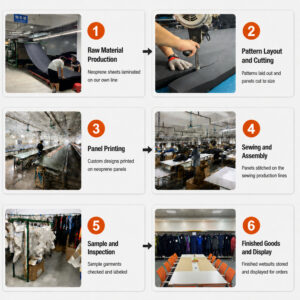
02 The Process, in Plain English
You don’t need to be a chemist to understand how a wetsuit is made. Here’s the simplified version:
-
Foaming — raw rubber is expanded into sheets of closed-cell foam. The density of those cells decides warmth and durability.
-
Lamination — fabric is glued to one or both sides of the foam sheet. This is where cheap products fail — bad glue = bubbles = suit falls apart in a year.
-
Cutting — panels are cut by hand or CNC from the laminated sheet. More panels = better fit = more labor cost.
-
Stitching — panels are sewn together. Flatlock, blindstitch, or overlock — each has a price point and a use case.
-
Finishing — zippers, cuffs, logos, and quality check before packing.
03 The Step That Causes the Most Returns
If we had to pick one stage that causes the most after-sales problems, it’s lamination. We’ve seen clients go with a cheaper factory to save 5% on fabric cost, only to have 15% of suits come back with delamination after one season.
The fix isn’t complicated — use water-based glue instead of solvent-based glue. It costs a bit more per meter, but the suit lasts 3–4x longer. We switched all our production to water-based glue years ago, and return rates dropped to under 2%.
04 What to Ask Your Factory Before You Order
These four questions will tell you more about a factory than any factory tour video:
-
“What glue do you use for lamination?” — if they don’t know what water-based glue is, walk away.
-
“How many panels are in a fullsuit?” — if the answer is under 8, the fit won’t be great.
-
“What’s your QC process for seams?” — they should be able to walk you through a water test or stretch test.
-
“What’s your defect rate on bulk orders?” — anything over 3% means you’ll be dealing with replacements.
05 Want to See How We Work?
We’re a full-chain factory — laminate, cut, sew, and QC all under one roof. If you’re launching a wetsuit brand and want to know exactly where your money goes, send us your spec and we’ll walk you through the cost breakdown step by step.
Request a quote — tell us what you’re building and your target price, and we’ll send you a sample plus a transparent cost breakdown.