
We’ve made spearfishing wetsuits for brands in Spain, Greece, Brazil, and the Philippines. Over the years, the most common mistake we see isn’t choosing the wrong thickness — it’s choosing a suit that’s built for surfing, not for hunting. Spearfishing is a different animal: you sit still, hold your breath, and need your shoulders free for that final shot. A wetsuit designed for movement-on-the-surface won’t cut it below the surface.

01 Why Spearfishing Neoprene Is Different
When a surfer is in the water, they’re moving almost constantly. When a spearo is on the hunt, they’re often hovering motionless for minutes at a time. That changes everything about what the suit needs to do:
-
Warmth matters more than drainage — you’re not generating heat through movement.
-
Shoulder mobility is non-negotiable — you need full arm extension for the shaft.
-
Silence matters — a noisy suit spooks fish before you even line up a shot.
These three requirements drive every material decision that follows.
02 Thickness: Go Slightly Thicker Than You Think
Our Mediterranean clients (water around 18–22°C) almost always start with 5mm, not 3mm. The reason: when you’re sitting still waiting for fish, your body doesn’t generate the same heat as when you’re paddling or swimming hard. Our rule of thumb:
-
24°C+ (tropical): 2–3mm is fine — think Philippines, Indonesia, Caribbean.
-
18–24°C (temperate): 3–5mm. Most of our Spanish and Portuguese clients land here.
-
10–18°C (cold): 5–7mm. Our Atlantic and Northern European clients go this thick.
If you’re on the fence between two thicknesses, go thicker. You can always vent a suit; you can’t add insulation after it’s sewn.
03 CR vs SBR: When to Spend the Extra
We get asked this on almost every spearfishing inquiry. Our honest take:
-
CR neoprene — better stretch, warmer, and it lasts longer in cold water. Worth it if your brand positions as performance spearfishing gear.
-
SBR neoprene — heavier, stiffer, but significantly cheaper. Fine for warm-water entry-level suits where the customer won’t be in the water for hours.
One thing we tell clients: don’t cheap out on the shoulder panels. Even if you use SBR for the body, spec CR or four-way stretch for the shoulders and upper back. That’s where the suit either works or fails.
04 The Details That Separate a Good Suit from a Great One
After making hundreds of these, the small details are what clients come back for:
-
-
Shoulder panels in four-way stretch — standard on every spearfishing suit we build, no exceptions.
-
Smooth-skin outer face — reduces drag underwater and cuts down on noise.
-
Flatlock inside, blindstitch at high-stress seams — comfortable against skin where it matters, watertight where it counts.
-
Knee pads pre-installed — our Mediterranean clients ask for this on every suit, since reef bottom is hard on knees.
-
-
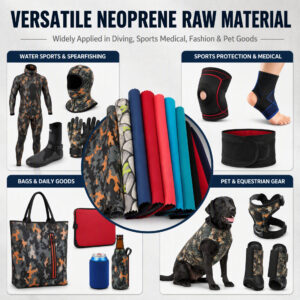
neoprene for spearfishing
05 What to Tell Your Factory Before They Quote
To get an accurate spearfishing wetsuit quote, send your factory these four things:
-
Where your customers actually dive — water temperature range matters more than your product spec sheet.
-
Your target price tier — entry-level, mid-range, or performance. It dictates CR vs SBR and seam type.
-
Sizing range — men’s, women’s, or both, and the size spread you need.
-
Any custom branding — printing, logos, or patches you want on the suit.
Skip these and you’ll go through three or four sample rounds before the suit is right.
06 Need Help Specifying Your Spearfishing Suit?
We’ve built spearfishing suits for brands across three continents. Tell us where your market dives and what price tier you’re targeting, and we’ll recommend the right neoprene spec — thickness, material, and construction — based on what’s actually worked for similar clients.
Request a quote — send us your water temperature range and target price point, and we’ll come back with a sample plan and timeline.